


Growth Navigate Funding is a critical tool for startups and small businesses aiming for sustainable growth and long-term success. Unlike standard startup funding, it focuses on aligning capital allocation with key operational milestones while ensuring financial discipline. This approach helps founders scale efficiently, optimize cash flow management, and achieve measurable results without risking stability.
By understanding the nuances of early stage growth, growth stage, and scale stage, businesses can strategically leverage venture capital, angel investors, or alternative financing to expand operations, improve revenue predictability, and maintain investor confidence. Proper planning transforms funding into a roadmap for success.
Understanding Growth Navigate Funding
Growth Navigate Funding refers to raising capital specifically for scaling business operations and achieving long-term growth. Unlike basic startup funding, which focuses on proving a concept, growth funding emphasizes measurable expansion, recurring revenue, and operational efficiency. Startups must link funding to strategic capital deployment and maintain clear financial readiness.
Without a plan, funding can be wasted or misused, leading to failure. Monitoring burn rate, preparing funding-ready financial packages, and understanding revenue predictability is essential. A structured approach ensures capital efficiency and smart capital use while supporting growth stages like early stage growth, growth stage, and scale stage.
What Growth Navigate Funding Really Means
Growth navigate funding is about more than just raising money; it ensures capital acquisition fuels product development, market expansion, and operational scalability. This form of funding requires careful funding allocation planning to avoid missteps and maintain investor relations. Startups must connect financial inflows to concrete operational milestones and metrics tracking.
Investors expect funding success metrics such as customer acquisition cost, monthly recurring revenue (MRR), and overall financial projections. Meeting these metrics signals financial readiness and reassures backers that the startup is a safe, high-potential opportunity.
Why Growth Funding Differs From Startup Funding
Startup funding often focuses on proving a business idea and gaining early-stage investment insights. Growth funding, on the other hand, targets capital efficiency, predictable revenue streams, and scaling a proven model. The shift requires strategic capital deployment, aligning funding with operational scalability, investor expectations, and long-term growth navigation strategy.
This difference explains why many startups struggle during expansion. Without linking funding to metrics tracking and funding-ready financial packages, businesses risk forced growth or overfunding without direction. Proper planning ensures capital supports long-term growth and smart capital allocation.
Startup Failure Reasons
Poor cash flow management, inadequate financial discipline, and misaligned funding mix cause most startup failures. Studies show 29% of startups fail from running out of cash, and 23% collapse due to weak product-market fit. Other failures arise from ignoring metrics tracking, misusing strategic capital, or failing to execute a growth strategy for startups.
Core Goals of Growth Navigate Funding
The main goal of growth navigate funding is to ensure capital fuels operational scalability and measurable expansion. Proper funding supports launching new products, entering new markets, and increasing monthly recurring revenue (MRR). A robust growth plan ensures every dollar contributes to long-term growth without unnecessary risk.
Founders must balance capital allocation planning with operational control, monitor burn rate, and maintain financial discipline. Investing in strategic partnerships or using non-dilutive capital can multiply growth and minimize ownership dilution, demonstrating smart capital management.
Read Also: BetterThisWorld Stocks: 14 Key Insights for Smart Investors
Fund Specific Growth Milestones
Matching funding options to operational milestones ensures that each round achieves tangible outcomes. For instance, Series A funding may focus on product development, market expansion, and strengthening investor alignment. Monitoring customer acquisition cost, MRR, and revenue predictability ensures measurable success.
A simple funding allocation table helps plan milestones:
| Funding Type | Purpose | % Allocation |
|---|---|---|
| Equity Funding | Product dev & market expansion | 50% |
| Debt Financing (Term Loans) | Operational support | 20% |
| Alternative Financing | Strategic partnerships & pilot projects | 15% |
| Non-Dilutive Capital/Grants | R&D & innovation | 15% |
Match Funding to Cash Flow
Cash flow management ensures growth is sustainable. Aligning funding mix with burn rate guarantees payroll, operational costs, and capital acquisition goals are met. Combining equity options, debt options, and alternative financing reduces dependency on a single source, increasing financial readiness.
Stress-testing funding scenarios helps plan for unforeseen events, making sure capital efficiency is maintained while protecting operational control. This disciplined approach strengthens investor relations and ensures future funding roadmap success.
Protect Stability While Scaling
Scaling too fast risks forced growth and operational collapse. Smart capital deployment ensures operational efficiency, controlled hiring, and focused strategic investment. Startups must track metrics tracking, maintain revenue predictability, and grow only when financial readiness is verified.
Investors value founders who demonstrate strategic capital deployment and maintain strong funding-ready financial packages. Sustainable, measured growth builds confidence in venture capital and angel investors, positioning the company for long-term growth.
Why Growth and Funding Are Always Linked

Growth and funding are inseparable. Capital drives expansion, and growth justifies investment. A startup without funding can’t scale, and without growth, investors hesitate. Linking funding strategy to growth navigation strategy, metrics tracking, and operational scalability ensures long-term growth.
Overfunding without direction dilutes equity, while underfunding stalls expansion. Proper capital allocation planning, maintaining financial discipline, and aligning with investor expectations ensures predictable, recurring revenue while avoiding common mistakes.
Read Also: Why Business Consulting Is Important: 12 Powerful Reasons for Smarter Growth
Growth Is Not Just “Getting Bigger”
True growth involves operational maturity, customer retention, and effective capital allocation. It is not just revenue increase. A clear funding roadmap connecting capital to strategic capital deployment ensures revenue predictability and protects operational control.
Avoid forced growth by monitoring burn rate, tracking metrics, and aligning with early-stage investment insights. This disciplined approach maximizes capital efficiency and supports long-term growth.
Healthy Growth vs. Forced Growth
Healthy growth aligns capital acquisition with operational milestones, ensuring financial discipline. Forced growth arises when startups expand too fast due to venture capital for SaaS pressure or mismanaged funding mix. Monitoring burn rate, recurring revenue, and capital efficiency avoids overextension.
Implementing metrics tracking, funding success metrics, and stress-testing plans safeguards startups from market shifts, enabling measured scaling business and smart capital use.
Growth Navigate Funding Stages Explained
Startups go through multiple funding stages, each with unique goals and funding options. Pre-seed funding and seed round are about proving the concept and establishing financial readiness. Founders must track burn rate, prepare funding-ready financial packages, and align capital allocation planning with early-stage investment insights.
Series A funding focuses on market expansion, revenue predictability, and operational scaling. By stress-testing plans, startups ensure smart capital deployment. Series B and beyond supports scaling business, strengthening metrics tracking, and achieving long-term growth without compromising operational control.
Pre-Seed and Seed Funding
Pre-seed funding is often bootstrapped or comes from angel investors. It supports product development, market testing, and minimal operations. Startups must track financial projections, monitor burn rate, and plan capital allocation to extend runway.
Seed rounds attract venture capital and strategic partners. Here, founders prove early-stage growth and showcase customer acquisition cost, monthly recurring revenue (MRR), and funding success metrics. Proper funding strategy ensures scalability and investor alignment.
Series A Funding Strategy
Series A funding is about turning validated products into scalable operations. Investors expect clear funding roadmap, metrics tracking, and strategic capital deployment. Funds are typically allocated to team growth, market expansion, and operational scalability.
Startups should focus on financial readiness, capital efficiency, and avoiding overfunding without direction. Implementing smart capital management ensures the business achieves long-term growth, strong investor relations, and measurable operational milestones.
Series B and Beyond
Series B and beyond provide growth equity to scale globally, optimize recurring revenue, and strengthen operational control. Founders must use funding mix wisely, combine debt financing, equity funding, and alternative financing, and track funding success metrics for investors.
Maintaining financial discipline and strong metrics tracking prevents forced growth and ensures capital efficiency. By following a growth navigation strategy, startups can achieve predictable revenue streams and long-term growth.
Common Types of Growth Navigate Funding
Startups have multiple funding options. Venture capital provides growth equity but requires strong metrics tracking. Angel investors offer early funding with strategic advice. Loans and debt give operational capital without diluting ownership. Alternative financing, like grants and competitions, revenue-based financing, or crowdfunding, supports financial readiness.
Different funding types serve different growth stages. Early-stage startups rely on bootstrapping, pre-seed funding, and seed rounds. Series A and Series B and beyond typically require venture capital for SaaS, growth equity, or strategic partnerships.
Venture Capital Funding
Venture capital fuels aggressive market expansion and scaling business. Investors expect funding-ready financial packages, metrics tracking, and a clear growth plan. While capital is significant, founders must maintain financial discipline, manage burn rate, and achieve operational milestones.
Angel Investors and Private Backers
Angel investors offer smaller capital but valuable investor expectations and advice. They support early-stage investment insights, helping startups validate ideas, optimize funding allocation planning, and build a strong funding roadmap for future rounds.
Bank Loans and Commercial Lending
Loans, including term loans, revolving credit facilities, invoice finance/factoring, and asset-based lending, provide non-dilutive capital. Proper financial readiness, risk management in funding, and capital efficiency are essential to ensure repayment while scaling operations.
Alternative Funding Approaches
Alternative funding includes crowdfunding, grants and competitions, and revenue-based financing. This non-dilutive capital allows startups to expand without equity loss. It requires strong funding mix planning, monitoring operational efficiency, and measuring funding success metrics.
Funding Source Distribution
| Funding Type | Ideal Stage | Typical Allocation | Notes |
|---|---|---|---|
| Angel Investors | Pre-seed/Seed | 20–30% | Early advice and validation |
| Venture Capital | Series A/B | 40–60% | Large-scale expansion |
| Bank Loans / Debt Financing | Growth Stage | 10–20% | Maintains operational control |
| Grants / Non-dilutive Capital | Early or Growth | 10–15% | Supports R&D and innovation |
Matching Funding to Your Growth Stage
Funding must match the startup’s stage. Early stage growth requires validating the idea, proving product-market fit, and tracking customer acquisition cost. Growth stage focuses on market expansion, scaling business, and optimizing capital allocation planning. Scale stage maximizes operational efficiency while achieving predictable recurring revenue.
A well-designed growth plan ensures funds align with operational milestones, metrics tracking, and investor expectations. Proper funding roadmap and stress-testing plan protect against market shocks and promote long-term growth.
Early Stage: Proving the Idea
At this stage, pre-seed funding or seed round supports product development, market testing, and validating revenue predictability. Focus on financial readiness, burn rate, and funding mix to prepare for Series A funding strategy.
Growth Stage: Expanding What Works
During the growth stage, funds expand market reach, scale teams, and optimize operational scalability. Using strategic partnerships, smart capital, and metrics tracking, startups achieve recurring revenue and demonstrate investor alignment.
Scale Stage: Optimizing and Defending
In the scale stage, startups focus on capital efficiency, maximizing long-term growth, and protecting operational control. Advanced funding roadmap, funding-ready financial packages, and stress-testing plans ensure stability while scaling globally.
Building a Growth Navigate Funding Plan
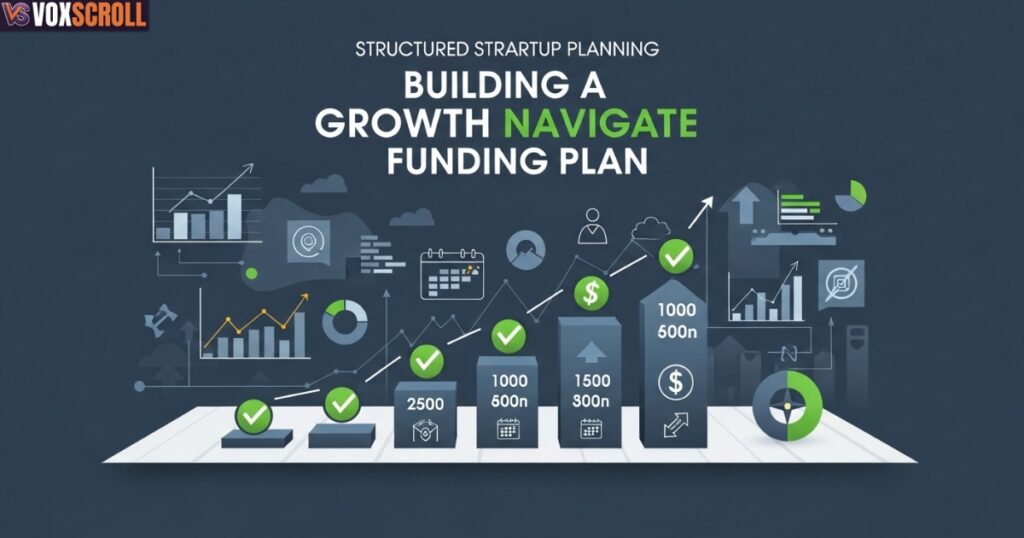
A strong plan starts with clear growth goals. Determine funding success metrics, burn rate, and capital allocation. Map each funding source to milestones and stress-test scenarios. This strategic capital deployment maximizes capital efficiency and ensures predictable revenue streams.
Founders should model scenarios for equity options, debt options, alternative financing, and non-dilutive capital. Regular review of metrics tracking, funding roadmap, and operational scalability builds confidence with angel investors and venture capital.
Read Also: What Is a FUPA? Facts, Causes & Treatments Explained Clearly
Start With Clear Growth Goals
Goals define success. Identify operational milestones, revenue predictability, and key metrics like MRR. This ensures capital acquisition directly supports long-term growth and prevents forced growth or overfunding without direction.
Understand Your Burn Rate
Burn rate measures cash usage versus growth. Track monthly expenses, payroll, and capital allocation planning. Proper monitoring prevents surprises and aligns with financial readiness and funding strategy.
Model Different Scenarios
Simulate funding outcomes using stress-testing plans and funding-ready financial packages. Compare equity options, debt options, grants, and alternative financing. This ensures capital efficiency, operational scalability, and alignment with investor expectations.
What Investors Look For in Growth Navigate Funding
Investors evaluate more than just ideas. They assess market opportunity and size, traction and revenue metrics, and the startup team’s quality. Proper funding strategy, clear financial projections, and a strong growth plan help founders meet investor expectations. Capital allocation planning is crucial to show efficient use of funds.
Metrics like customer acquisition cost, monthly recurring revenue (MRR), and recurring revenue provide insights into financial readiness. A solid funding roadmap demonstrates operational efficiency, strategic investment, and the ability to scale sustainably, ensuring long-term growth and maintaining strong investor relations.
Market Opportunity and Size
Investors seek large, addressable markets. A startup must show potential for market expansion and scaling business. Evidence of revenue predictability and early-stage investment insights signals that the business can sustain long-term growth without overextending resources.
Traction and Revenue Metrics
Metrics like MRR, retention rates, and burn rate reveal whether a startup can maintain growth. These funding success metrics inform capital allocation planning and help investors gauge operational scalability and strategic capital deployment.
Team Quality and Experience
A strong, experienced team ensures operational control, smart capital usage, and proper strategic investment. Investors expect founders to demonstrate financial discipline, metrics tracking, and the ability to achieve operational milestones.
Building Strong Investor Relationships
Finding the right investors is critical. Startups must research angel investors, venture capital, and strategic partnerships aligned with their growth navigation strategy. Investor alignment and mutual expectations reduce conflicts and improve funding success metrics.
Crafting compelling pitch decks and presenting a clear funding-ready financial package builds trust. Showcasing financial projections, capital efficiency, and operational scalability highlights how the startup plans long-term growth and maintains investor expectations.
Researching the Right Investors
Identify investors with experience in your sector. Look at prior investments and strategic capital deployment. Aligning investor expertise with your growth plan ensures both funding allocation planning and capital efficiency.
Crafting Compelling Pitch Materials
A strong pitch deck includes financial readiness, funding roadmap, operational milestones, and key metrics tracking. Highlight smart capital use and strategic investment to demonstrate preparedness for scaling.
How Market Conditions Affect Funding and Growth
Economic trends, interest rates, and industry dynamics affect funding options. During downturns, loans and debt may be harder to obtain. Founders must adjust growth strategy for startups, maintain financial discipline, and explore alternative financing like grants, crowdfunding, or revenue-based financing.
Market shifts also impact valuation metrics, capital acquisition, and funding-ready financial packages. Stress-testing capital allocation planning against fluctuating revenue predictability ensures startups avoid overextending while scaling.
Alternative Growth Navigate Funding Strategies
Startups can use strategic partnerships and corporate venture to access smart capital and expand markets. Grants and non-dilutive capital support product development without giving up equity. These alternative financing strategies enhance operational scalability, improve funding success metrics, and ensure long-term growth.
Strategic Partnerships and Corporate Venture
Collaborating with established companies provides funding, expertise, and network access. This approach reduces financial risk, strengthens operational efficiency, and supports scaling business.
Grants and Non-Dilutive Capital
Non-equity funding like grants and competitions allows startups to focus on product development and early-stage growth without losing operational control. It improves capital efficiency and boosts funding success metrics.
Common Funding Mistakes Founders Make
Founders often chase growth too early, overfund without direction, or ignore cash flow management. These mistakes jeopardize long-term growth and erode investor alignment. Strong financial discipline and a clear growth navigation strategy are essential.
Chasing Growth Too Early
Rapid expansion without proven revenue predictability or operational milestones can strain cash flow management. Sustainable growth relies on careful funding allocation planning and capital efficiency.
Overfunding Without Direction
Excess capital without a growth plan leads to inefficient spending. Align funding mix with strategic investment, operational scalability, and metrics tracking.
Ignoring Cash Flow
Neglecting burn rate or recurring revenue can cause liquidity crises. Track financial projections, ensure capital acquisition aligns with growth strategy for startups, and stress-test scenarios.
Using Funding to Support Smart Growth
Funding should fuel scaling business, improve operational efficiency, and strengthen revenue predictability. Invest where growth compounds, hire carefully, and measure metrics tracking for capital allocation planning. This approach ensures long-term growth and financial readiness.
Invest Where Growth Compounds
Allocate funds to product development, market expansion, and customer acquisition cost optimization. This strategic capital deployment ensures maximum return.
Hire Carefully
New hires should align with operational scalability and contribute to funding success metrics. Avoid bloated teams that increase burn rate without improving recurring revenue.
Measure What Matters
Track key metrics tracking, funding success metrics, and operational milestones. Use financial projections to adjust capital allocation planning for long-term growth.
Bridging the Growth Capital Gap
Startups may face temporary capital gaps. Strategies include asset-based lending, invoice finance / factoring, term loans, or revolving credit facilities. Debt options complement equity options to maintain operational control and ensure scaling business without disrupting revenue predictability.
Key Organizations Commonly Linked to Growth Navigate Funding
SBA, Y Combinator, Techstars, and major venture capital firms are vital for small business funding. These organizations provide early-stage investment insights, access to strategic partnerships, and opportunities for long-term growth.
Growth Navigate Funding Timeline Considerations
Timing is crucial. Managing multiple funding conversations and preparing for due diligence ensures capital acquisition aligns with operational milestones. A well-planned funding roadmap supports financial readiness and protects against market fluctuations.
Growth Navigate Funding Best Practices
Set concrete capital goals, maintain financial discipline, and implement capital efficiency measures. Use metrics tracking, funding mix, and strategic capital deployment to achieve long-term growth and satisfy investor expectations.
Growth Navigate Funding for Small Businesses
Small business funding relies on grants, loans, and equity funding. Startups must assess funding options, maintain operational control, and create funding-ready financial packages. Focused capital allocation planning ensures financial readiness and sustainable growth.
Should You Travel Abroad for Funding?
Some startups explore international funding for better valuation metrics and access to venture capital for SaaS. Pros include expanded networks, smart capital, and strategic advice. Cons involve costs, legal risks, and unfamiliar market conditions.
Pros and Cons of Financial “Medical Tourism”
Abroad funding offers non-dilutive capital and strategic partnerships. However, cross-border compliance and operational complexity increase risk. Compare benefits against capital efficiency and financial readiness.
Cost Comparison and Safety Tips
Assess equity options, debt options, and travel expenses. Use safe, verified investors and track funding success metrics to minimize risks and maximize long-term growth.
Long-Term Thinking Beats Short-Term Wins
Smart founders prioritize long-term growth over quick wins. Effective capital allocation planning, metrics tracking, and strategic investment protect operational scalability. Avoid forced growth, maintain financial discipline, and track recurring revenue for sustained success.
FAQs About Growth Navigate Funding
What does growth funding mean?
Growth funding is capital provided to a business to scale operations, expand markets, or develop products after achieving early success.
What are the 4 stages of funding?
The four main funding stages are Pre-Seed, Seed, Series A, and Series B and beyond.
What are the three types of funding?
The three types are Equity funding, Debt financing, and Alternative financing like grants or revenue-based loans.
What is growth stage funding?
Growth stage funding supports companies with proven products to expand market reach, hire teams, and scale operations efficiently.
How do growth funds work?
Growth funds invest capital in companies showing recurring revenue and scalable operations, expecting returns as the business grows.
What are the 4 stages of organizational growth?
Organizations typically grow through Startup, Growth, Maturity, and Renewal or Decline stages.
What are the 4 pillars of growth?
The four pillars are Market expansion, Operational efficiency, Revenue predictability, and Strategic investment.
What is the 5 stage growth model?
The five stages include Idea/Concept, Startup, Growth, Expansion, and Maturity/Exit.
What are the 4 areas of growth and development?
They focus on People, Processes, Products, and Profits, ensuring holistic business growth.
Key Takeaways to Remember
Growth navigate funding requires clear growth plans, tracking metrics tracking, and maintaining financial discipline. Align capital allocation planning with operational milestones and choose funding options suited for your stage. Sustainable growth depends on strategic investment, smart capital, and strong investor relations.
Final Thoughts
Achieving long-term growth needs careful growth navigation strategy, effective capital efficiency, and funding-ready financial packages. Whether leveraging angel investors, venture capital, debt financing, or alternative financing, startups must maintain operational control, track funding success metrics, and plan for scaling business responsibly.

Ali Hussnain is a digital content writer at VoxScroll. He covers celebrity biographies, social media personalities, entertainment news, and trending online topics. His writing focuses on clear information, reliable sources, and reader-friendly content.