

Startup booted fundraising strategy is rapidly becoming the go-to approach for founders seeking Founder-led growth without sacrificing control. Unlike traditional venture capital, this method relies on Bootstrapping startups and Revenue-based funding, enabling Financial self-reliance while turning early customers into key supporters. By focusing on Lean startup methodology and Operational efficiency, founders can validate products, generate Early-stage revenue, and reinvest profits strategically.
This Revenue-first mindset empowers startups to scale sustainably, maintain Founder ownership retention, and navigate economic uncertainty with confidence. Understanding this strategy is crucial for entrepreneurs aiming for Sustainable growth strategy and long-term Startup resilience in a competitive market.
What Is a Startup Booted Fundraising Strategy?
Definition and Core Concept
A Startup Booted Fundraising Strategy is a Self-funded startup approach where founders prioritize cash flow discipline and financial self-reliance. The goal is to grow the business using Customer-funded growth and Revenue-focused strategy rather than chasing venture capital. This approach empowers startups to invest in Early-stage revenue streams and Minimum viable product (MVP) testing, ensuring every dollar contributes to Sustainable startup strategy and Long-term sustainability.
The concept relies heavily on Founder-led business strategy and Lean startup principles, emphasizing Operational discipline and Limited capital management. Founders are encouraged to use Personal savings investment, Side-hustle bootstrapping, and Profit reinvestment strategy to maintain Founder ownership retention while scaling. Unlike traditional VC models, this method avoids equity dilution, letting founders control Strategic decision-making and Business fundamentals.
Bootstrapping vs Traditional Fundraising
Bootstrapping startups differ greatly from VC-funded companies. Traditional fundraising focuses on rapid growth, often ignoring profitability. Investors demand equity and influence decisions, creating pressure to scale prematurely. In contrast, a Bootstrapped funding model emphasizes Financial planning for startups, Revenue-driven expansion, and Operational efficiency, allowing founders to focus on Customer validation and Internal revenue growth.
By relying on Early monetization and Minimal external funding, bootstrapped startups maintain Founder-friendly financing. This approach ensures Startup resilience and adaptability during economic uncertainty. While VC-funded startups chase large markets, Self-sufficient startup growth focuses on Strategic reinvestment and Cash flow monitoring, letting founders prioritize Long-term business growth.
Why Founders Are Choosing This Path
Many founders prefer Founder independence over external influence. Revenue-first mindset ensures that customer needs drive product development and growth. Customer-funded growth reduces financial stress and allows Founder skills leverage to implement Strategic business growth without sacrificing control.
Booted startup success stories demonstrate that careful Cash flow management and Discipline in startup operations lead to Long-term startup success. Founders can use Early revenue generation to validate Product-market fit while keeping ownership. The strategy fosters Sustainable growth strategy that is resilient against Economic uncertainty and market volatility.
Read Also: Niaikailuo: 14 Powerful Insights You Must Know
The Philosophy Behind Booted Fundraising
Ownership-First Thinking
At its core, booted fundraising prioritizes Founder ownership retention. Founders maintain full decision-making power and avoid pressure from external investors. By implementing Lean operations and Operational control, founders can make decisions that support Sustainable scaling.
This philosophy encourages Strategic fundraising readiness, ensuring that any external investment aligns with long-term goals. Founder-led business strategy emphasizes Profit reinvestment over immediate external funding, fostering Sustainable startup strategy while maintaining Team efficiency and Operational discipline.
Revenue Over Valuation
Unlike VC-funded startups, Bootstrapped startup advantages lie in generating Early-stage revenue. Founders focus on Revenue-driven expansion instead of chasing inflated valuations. Revenue-based funding and Early monetization allow startups to grow based on actual customer demand rather than speculative investor expectations.
This approach creates Sustainable startup strategy, emphasizing Customer-first growth and Customer validation. By prioritizing Cash flow discipline and Internal revenue growth, startups avoid the pitfalls of scaling too fast or losing Founder ownership retention.
Control and Independence
Control is central to booted fundraising. Founder independence ensures that all Strategic decision-making reflects the startup’s vision. By applying Disciplined spending and Financial self-reliance, startups can manage growth without sacrificing equity or mission.
Lean team structure and Operational efficiency help maintain Startup resilience. This model allows founders to experiment with Iterative product development and Revenue-focused strategy, which builds Sustainable scaling without investor interference.
Why Startup Booted Fundraising Strategy Is Growing in 2026
Market Shifts and VC Slowdowns
VC funding has slowed in recent years due to Economic uncertainty. Founders now turn to Bootstrapped funding models that rely on Revenue-based funding and Internal revenue growth. This shift prioritizes Early revenue generation and Profit reinvestment strategy over chasing venture capital.
Bootstrapped startups show higher Startup resilience during market volatility. By focusing on Lean startup methodology and Cost-efficient startup operations, founders ensure Sustainable startup strategy and Long-term business growth, even in uncertain markets.
Founder Preference for Equity Control
Founders increasingly value Ownership retention and Founder-led growth. Retaining equity ensures Strategic decision-making aligns with long-term goals. By relying on Self-funded startup models and Customer-funded growth, founders avoid equity dilution and retain full control of operations.
This approach encourages Lean operations and Revenue-driven expansion, ensuring Sustainable scaling without external pressures. Financial planning for startups becomes simpler, and founders can leverage Founder skills to grow strategically.
Profitability Over Hypergrowth
Bootstrapped startups prioritize Revenue-first mindset over chasing valuations. Profit reinvestment and Internal revenue growth fuel Sustainable growth strategy. This reduces the risk of Startup scaling without external capital and builds a Long-term startup success trajectory.
By focusing on Customer-first growth, founders ensure that Early-stage revenue drives expansion. Operational discipline and Cash flow monitoring support Financial self-reliance, allowing startups to grow steadily without compromising control or Founder ownership retention.
Revenue-First Mindset: Turning Customers Into Capital
Customers as Primary Investors
In a Customer-first business model, paying customers become the main source of funding. Instead of raising capital, founders rely on Revenue-based funding and Early monetization to drive growth. This ensures Operational efficiency and Startup resilience while maintaining Ownership retention.
Booted startup success stories show that Customer engagement and retention provide both revenue and validation. By emphasizing Customer-first growth, startups create a Revenue-focused strategy that builds Sustainable startup strategy over time.
Early Sales as Validation
Revenue from early customers serves as a validation tool for product-market fit. By applying Minimum viable product (MVP) principles, founders test demand before scaling. Iterative product development ensures that Customer validation guides Strategic business growth.
Early-stage revenue strengthens Financial planning for startups, allowing for Profit reinvestment and Operational discipline. This approach reduces risk and encourages Lean team structure to deliver Revenue-driven expansion efficiently.
Cash Flow as Growth Engine
Strong Cash flow management is the backbone of Bootstrapped funding models. It powers Revenue-driven expansion, Early revenue generation, and Long-term sustainability. Founders rely on Internal revenue growth to fund operations, avoiding reliance on investors.
Financial self-reliance ensures that Disciplined spending supports Sustainable startup strategy. A Customer-first business model combined with Profit reinvestment strategy creates Long-term business growth while maintaining Founder independence.
4 Core Types of Booted Fundraising Strategies
Personal Savings Bootstrapping
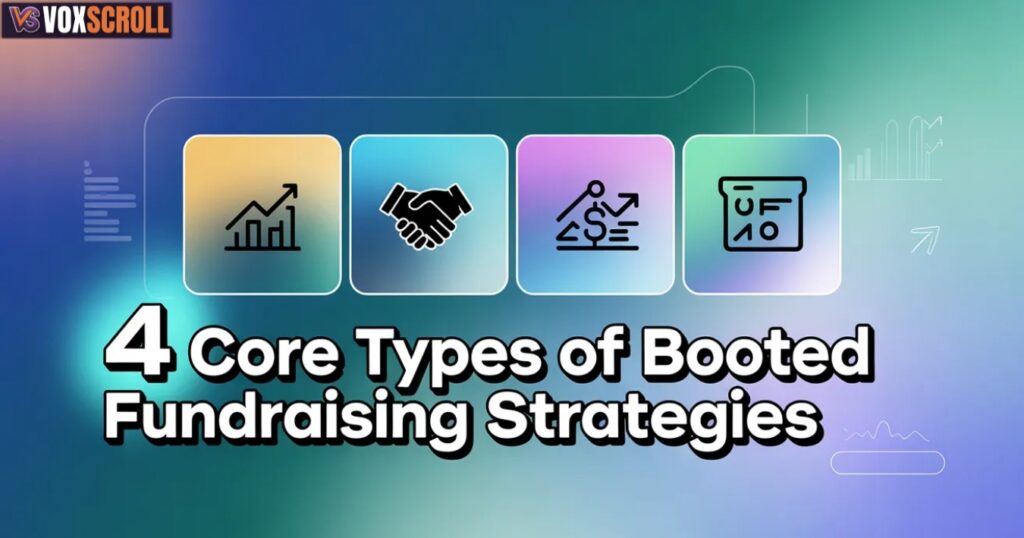
The simplest form of booted fundraising is Personal savings investment, where founders invest their own money to start a Self-funded startup. Using Limited capital management, this approach forces careful Disciplined spending and prioritization of essential operations. Founder-led growth benefits from this method as it keeps Ownership retention intact while demonstrating early Cash flow discipline.
Founders can combine Early-stage revenue with Personal savings investment to maintain Financial self-reliance. This method encourages Strategic decision-making and builds Startup resilience, making it ideal for founders who want to control growth without Venture capital vs bootstrapping pressures.
Revenue-Based Bootstrapping
Revenue-based funding allows founders to grow using profits generated from initial sales. This approach transforms a Customer-first business model into a Revenue-focused strategy, where Early revenue generation supports Operational efficiency. Startups can reinvest profits to fund Revenue-driven expansion while maintaining Founder independence.
By focusing on Internal revenue growth and Profit reinvestment strategy, founders build a Sustainable growth strategy. Bootstrapped company advantages include slower, manageable scaling and Team efficiency, ensuring every dollar contributes to Long-term sustainability.
Side-Hustle Bootstrapping
Founders often start Side-hustle bootstrapping by funding startups through part-time ventures. This Self-sufficient startup growth model allows them to maintain Operational discipline while testing Customer-first growth strategies. By leveraging Founder skills, early monetization becomes a reliable funding source.
This method reduces reliance on external capital, fostering Lean operations and Financial planning for startups. Early profits can be reinvested for Strategic business growth, creating a Booted startup success story even with limited initial investment.
Lean Bootstrapping Model
The Lean startup methodology emphasizes minimal spending, Operational efficiency, and rapid learning. By applying Minimum viable product (MVP) testing and Iterative product development, founders focus on Product validation while managing Limited capital management. Every decision is Revenue-focused, helping startups achieve Sustainable scaling.
The model supports Disciplined spending and Cash flow discipline, ensuring Early revenue generation funds Lean operations. Founders retain Ownership retention, making it easier to adapt to market shifts and maintain Long-term startup success.
Building a Lean Startup From Day One
Validating Product-Market Fit
Product-market fit is essential for Revenue-first mindset. Startups must test Customer validation early, ensuring the product solves a real problem. Iterative product development allows founders to refine offerings before scaling.
Early sales provide Internal revenue growth, supporting Bootstrapped funding models. This approach strengthens Operational discipline and ensures that Strategic decision-making is based on actual customer behavior, not speculation.
Minimum Viable Product Strategy
A Minimum viable product (MVP) focuses on essential features that solve core problems. Lean startup principles guide founders to avoid Feature creep while testing market interest. MVP testing encourages Early monetization and Customer engagement and retention, creating Revenue-driven expansion.
By emphasizing Cash flow discipline and Profit reinvestment, startups ensure Financial self-reliance. MVPs allow Founder-led business strategy to evolve based on Customer-first growth, creating a Sustainable startup strategy from day one.
Avoiding Feature Creep
Feature creep wastes resources and undermines Disciplined spending. Lean team structure ensures the focus remains on Revenue-focused strategy and core functionality. Operational discipline maintains Team efficiency and Strategic decision-making.
Startups that avoid feature creep achieve Early-stage revenue faster, supporting Revenue-based funding and Customer-funded growth. This strategy strengthens Startup resilience and lays the foundation for Long-term sustainability.
Read Also: Voozon: 18 Powerful Ways It Transforms Digital Connectivity
Financial Discipline as the Backbone of Booted Startups
Expense Tracking Systems
Entrepreneur financial discipline starts with robust expense tracking. Using Operational efficiency tools, founders maintain Disciplined spending and monitor Cash flow management. Accurate tracking ensures Financial self-reliance and supports Strategic business growth.
Startups can categorize Fixed vs variable costs to plan for Revenue-driven expansion. This discipline strengthens Startup resilience and ensures Long-term startup success.
Revenue Forecasting Methods
Internal revenue growth depends on accurate Revenue-focused strategy forecasts. Founders can use historical data, market trends, and Early revenue generation to project future cash flow. Forecasting supports Sustainable scaling and Strategic decision-making.
By predicting income, startups can allocate Profit reinvestment strategy effectively. This approach ensures Financial self-reliance, Operational discipline, and Long-term business growth.
Emergency Fund Planning
An emergency fund is critical for Bootstrapped startup advantages. It supports Startup resilience during unexpected challenges and ensures Limited capital management. Revenue-based funding alone may not cover sudden expenses, making a safety buffer essential.
Disciplined spending combined with Cash flow monitoring builds Sustainable startup strategy. Founders can focus on Revenue-driven expansion without risking Long-term startup success.
Smart Cost Management in Bootstrapped Companies
Fixed vs Variable Costs
Understanding Fixed vs variable costs is crucial in a Bootstrapped company. Fixed costs like rent or salaries remain constant, while variable costs like marketing spend fluctuate with sales. Disciplined spending ensures Limited capital management and Operational efficiency.
Monitoring both types of costs allows for Revenue-driven expansion without unnecessary risk. Bootstrapped company advantages include the flexibility to cut variable costs quickly, maintaining Financial self-reliance and supporting Early-stage revenue growth.
Reducing Burn Rate
Burn rate reduction is essential for Founder-led growth. By cutting unnecessary expenses, renegotiating vendor contracts, and prioritizing Cost-efficient startup operations, founders extend runway and reduce dependency on external funds.
Cash flow discipline, combined with Profit reinvestment strategy, ensures that startups can survive Economic uncertainty while scaling sustainably. This approach underlines Sustainable startup strategy and Startup resilience.
Negotiation With Vendors
Negotiating favorable terms with suppliers and service providers is a hallmark of Bootstrapped funding model startups. Leveraging Founder skills and demonstrating Revenue-first mindset can secure discounts, deferred payments, or revenue-sharing arrangements.
This reduces operational costs while maintaining Operational discipline. Many Booted startup success stories show how smart negotiations improved Financial self-reliance, supported Internal revenue growth, and enabled Sustainable scaling without equity dilution.
Marketing on a Budget Without Burning Cash
Organic Growth Strategies
Bootstrapped funding model startups thrive on Organic growth. Instead of expensive campaigns, founders focus on building Customer-first business models and leveraging free platforms like social media, blogs, and email newsletters. Revenue-focused strategy encourages using early revenue to reinvest in low-cost, high-impact marketing tactics.
Tracking Customer engagement and retention helps optimize campaigns. Many Booted startup success stories show that Organic growth channels produce sustainable traffic without draining cash, reinforcing Financial self-reliance and Startup resilience.
Word-of-Mouth & Referrals
Customer-first growth is accelerated by Word-of-mouth & referrals. Happy customers act as investors in the Revenue-first mindset, boosting Internal revenue growth and validating the Minimum viable product (MVP). Incentivizing referrals, loyalty programs, or offering early-access products can amplify reach without extra cost.
This approach reinforces Founder-led growth, maintains Operational efficiency, and supports Sustainable startup strategy. It’s a key tool for Startup scaling without external capital and Customer-funded growth.
Content Marketing for Authority
Building authority through Content marketing creates long-term benefits. Publishing blogs, guides, and case studies increases visibility and establishes a Customer-first business model. Using Lean startup methodology, content can focus on educating customers while driving Early-stage revenue and fostering Revenue-driven expansion.
Bootstrapped company advantages include flexibility to test strategies and scale what works. By leveraging Organic growth channels, startups gain Financial self-reliance and improve Founder ownership retention.
Hiring Strategically in a Booted Startup
When to Hire
Founder-led business strategy demands strategic hires. Hiring too early risks Limited capital management, while too late can slow Operational efficiency. Founders should hire when Early revenue generation justifies the cost and aligns with Revenue-focused strategy.
Prioritizing roles that directly impact Revenue-first mindset or Customer-funded growth ensures Long-term startup success without diluting ownership or overextending resources.
Freelancers vs Full-Time Employees
Lean team structure allows startups to balance talent and cost. Freelancers offer flexibility and Cost-efficient startup operations, while full-time hires ensure Team efficiency and commitment to Sustainable startup strategy.
Choosing carefully supports Operational discipline, reduces burn rate, and strengthens Founder-led growth. Many Booted startup success stories highlight a hybrid team as a key to Startup resilience.
Building a High-Ownership Culture
A Founder-led growth culture emphasizes accountability and Ownership retention. Every team member should understand the value of Cash flow discipline and Profit reinvestment strategy.
Sustainable growth strategy thrives when employees think like owners. This culture enhances Strategic decision-making, reduces oversight needs, and builds Long-term startup success.
Product Development in a Bootstrapped Model
Solving One Core Problem
Focusing on Product validation ensures Early monetization and Customer-funded growth. Minimum viable product (MVP) development allows startups to solve one key customer pain point before expanding features.
Iterative product development with customer feedback drives Revenue-focused strategy. Bootstrapped company advantages include agility and reduced risk compared to Venture capital vs bootstrapping approaches.
Rapid Iteration From Customer Feedback
Customer-first growth is reinforced through continuous improvement. Using Customer engagement and retention data, founders refine products to boost Early-stage revenue and Revenue-driven expansion.
This method strengthens Startup resilience and adaptability, ensures Financial self-reliance, and maintains Operational efficiency without costly pivots.
Prioritizing Profit-Generating Features
Startups should prioritize features that directly impact Cash flow discipline and Revenue-first mindset. Lean startup principles guide founders to focus on profitable initiatives rather than vanity features.
Revenue-focused strategy encourages Profit reinvestment, building a Sustainable startup strategy and ensuring Startup scaling without external capital remains viable.
Booted Fundraising vs Venture Capital Funding
Ownership and Equity Comparison
Founder ownership retention is a key advantage of Bootstrapped funding model startups. Unlike VC-funded businesses, booted startups maintain full equity, preserving control over Strategic business growth and long-term vision.
Financial self-reliance and Operational control allow founders to avoid the pressure of rapid Business scaling without investors, which is common in venture-backed models.
Growth Pressure Differences
VC-backed startups face hypergrowth expectations. Booted startup success stories show Revenue-driven expansion can be slower but sustainable, with focus on Internal revenue growth and Sustainable scaling.
This reduces Founder stress management issues and supports Long-term startup success without equity dilution.
Risk and Exit Strategy Analysis
Risk mitigation in startups is easier in booted models because founders control Minimal external funding and Strategic reinvestment. Exit options can be planned carefully without pressure to sell quickly.
Founder-led business strategy promotes Sustainable startup strategy and ensures Long-term sustainability, avoiding premature exits or market dependency.
Non-Dilutive Funding Options to Support Booted Growth
Grants and Government Programs
Bootstrapped funding model startups can access Venture capital alternatives like grants and government programs. These provide funding without giving up Founder ownership retention or equity. Programs targeting Early-stage startups often reward innovation, technology, or community impact, enabling Customer-funded growth while maintaining Financial self-reliance.
Revenue-focused strategy benefits when funds are reinvested for Operational efficiency or scaling Lean operations, creating a Sustainable startup strategy without external pressure.
Revenue-Based Financing
Revenue-based funding allows startups to borrow against Early revenue generation rather than equity. This aligns with a Revenue-first mindset and maintains Founder independence while funding growth.
Startups using Cash flow discipline and Profit reinvestment strategy can manage repayments without risking Long-term startup success, supporting Sustainable scaling and Operational discipline.
Strategic Partnerships
Forming alliances with larger companies or suppliers provides capital, resources, or market access without equity dilution. Founder-led business strategy benefits from Strategic business growth and improved Team efficiency.
These partnerships enhance Customer engagement and retention and accelerate Revenue-driven expansion while keeping the startup’s Financial self-reliance intact.
Read Also: Melanie Craigscottcapital: 15 Powerful Insights You Should Know
Common Mistakes in Startup Booted Fundraising Strategy
Underestimating Costs
Many founders fail by not planning for Limited capital management. Ignoring expenses beyond initial estimates can disrupt Cash flow monitoring and slow Early monetization.
Using Financial planning for startups tools, tracking Early-stage revenue, and forecasting expenses ensures Discipline in startup operations and Long-term business growth.
Poor Cash Flow Management
Ignoring Cash flow discipline undermines Revenue-first mindset. Even profitable startups can fail if Revenue-focused strategy is not backed by Financial self-reliance.
Regular monitoring, setting aside Emergency fund planning, and applying Founder-led growth principles helps mitigate Risk in startups and strengthens Startup resilience.
Scaling Too Slowly or Too Fast
Startup scaling without external capital requires careful timing. Scaling too fast risks exhausting cash, while too slow can lose Market momentum and Customer engagement and retention.
Following Lean startup methodology and Operational discipline allows Sustainable scaling and Revenue-driven expansion, balancing growth and stability.
Measuring Success in a Booted Startup
Profitability Metrics
Tracking profits ensures Founder ownership retention and supports Revenue-focused strategy. Startups can measure Internal revenue growth, Profit reinvestment, and Cash flow monitoring to validate Long-term startup success.
Financial self-reliance is built by reinvesting profits strategically, ensuring Sustainable startup strategy and avoiding Minimal external funding pitfalls.
Customer Lifetime Value
Understanding Customer engagement and retention helps prioritize Customer-funded growth. High Early-stage revenue per customer signals success and informs Revenue-driven expansion.
Customer-first business model decisions guided by metrics ensure Operational efficiency and strengthen Startup resilience and adaptability.
Sustainable Growth Indicators
Metrics like recurring revenue, retention, and cash conversion highlight Sustainable startup strategy. Using Founder-led growth and Financial self-reliance as benchmarks ensures Long-term business growth without overextending resources.
Disciplined spending and Revenue-focused strategy reinforce Bootstrapped company advantages, maintaining Operational discipline as the business scales.
Scaling Without Losing the Bootstrapped Edge
Controlled Expansion
Startup resilience depends on Operational efficiency while scaling. Controlled growth ensures Profit reinvestment strategy and Revenue-first mindset stay intact, avoiding dilution or loss of Founder independence.
Revenue-driven expansion paired with Lean team structure preserves Customer-first growth and supports Long-term sustainability.
Maintaining Culture
Culture impacts Founder-led growth and Team efficiency. High-ownership culture ensures Customer engagement and retention and reinforces Operational discipline.
Even with growth, keeping Lean operations and Founder skills leverage intact fosters Booted startup success stories and strengthens Sustainable startup strategy.
Operational Efficiency
Scaling requires Operational discipline, Lean operations, and Cash flow monitoring. Revenue-focused strategy should guide resource allocation, preventing over-spending and preserving Financial self-reliance.
Founder-led business strategy and Strategic decision-making ensure long-term Startup resilience while pursuing Sustainable scaling.
Psychological Challenges of Booted Fundraising
Founder Stress Management
Founder independence comes with responsibility. Managing a revenue-first mindset, Cash flow discipline, and Operational control can be stressful.
Bootstrapped startup success stories show mindfulness, scheduling, and delegation improve Founder skills leverage, promoting Startup resilience and adaptability.
Staying Motivated Without Investor Validation
Without external pressure, Founder-led growth requires Revenue-driven expansion motivation. Early monetization and tracking Customer engagement and retention provide validation.
Focusing on Profit reinvestment strategy and Financial self-reliance helps founders maintain drive and Sustainable startup strategy.
Decision Fatigue
Strategic decision-making is constant in booted startups. Founders must prioritize Operational discipline and Lean operations to avoid burnout.
Using frameworks for Revenue-focused strategy and Internal revenue growth ensures Long-term startup success and prevents mistakes from fatigue.
Legal and Compliance Essentials for Bootstrapped Startups
Business Structure Selection
Choosing the right legal entity safeguards Founder ownership retention and limits Risk in startups. Incorporating LLCs or S-Corps enhances Financial self-reliance and supports Long-term startup success.
Startup resilience and adaptability is reinforced through proper Business fundamentals and Operational control.
Contracts and IP Protection
Protecting intellectual property ensures Founder-led growth and maintains Revenue-focused strategy advantages. Drafting clear contracts prevents disputes and secures Customer-funded growth.
Operational discipline combined with Revenue-driven expansion protects Long-term sustainability and Booted startup success stories.
Tax Planning Basics
Disciplined spending and Financial planning for startups are crucial. Tax optimization ensures Minimal external funding is sufficient for growth while enhancing Profit reinvestment strategy.
Proper planning strengthens Founder-led business strategy, Sustainable startup strategy, and Long-term startup success.
Real Examples of Successful Booted Startups
SaaS Growth Stories
Companies like Basecamp and Mailchimp show Revenue-first mindset fuels Revenue-driven expansion. Customer-funded growth leads to Financial self-reliance and Founder ownership retention.
These examples highlight Booted startup success stories, emphasizing Lean startup principles and Sustainable startup strategy.
E-Commerce Bootstrapped Brands
E-commerce brands like Gymshark and Fashion Nova achieved Early-stage revenue and Organic growth using Lean operations and Cash flow discipline.
Their Profit reinvestment strategy and Customer-first growth provide lessons for Startup scaling without external capital.
Service-Based Businesses
Agencies and consultancies often start Self-funded startup models, focusing on Early monetization and Internal revenue growth.
They show Founder-led growth and Operational efficiency are keys to Sustainable startup strategy and Long-term business growth.
Global Trends in Booted Fundraising Strategy
Rise of Remote-First Companies
Remote-first startups lower overhead, reinforcing Limited capital management and Lean operations. Operational discipline and Revenue-driven expansion are easier with distributed teams.
This supports Financial self-reliance and Customer-first business model, fostering Sustainable scaling globally.
Technology Enabling Lean Operations
Cloud tools, Automation for small teams, and analytics enable Operational efficiency in Bootstrapped funding model startups. Founder skills leverage ensures Revenue-focused strategy thrives.
Internal revenue growth and Early-stage revenue can fund scaling without external investors.
International Founder Communities
Global networks share insights on Revenue-first mindset, Lean startup principles, and Operational discipline.
Participation accelerates Founder-led business strategy, Startup resilience, and Sustainable startup strategy, supporting Long-term business growth.
Tools That Power Bootstrapped Startups
Free and Low-Cost SaaS Tools
Startups use tools like Slack, Trello, and HubSpot to save on Cost-efficient startup operations. These improve Lean team structure, Operational efficiency, and Strategic decision-making.
Revenue-focused strategy benefits from tracking Early-stage revenue and maintaining Financial self-reliance.
Automation for Small Teams
Automation reduces manual work, supporting Operational discipline and Team efficiency. Cash flow monitoring and marketing automation reinforce Revenue-driven expansion without extra hires.
Founder-led growth and Lean operations thrive with Booted startup success stories as benchmarks.
Analytics for Smarter Decisions
Analytics guide Customer-first growth, Product validation, and Revenue-focused strategy. Metrics track Customer engagement and retention, Early revenue generation, and Internal revenue growth.
These insights support Sustainable startup strategy and Long-term startup success.
When to Introduce External Investors
Raising From Strength
Only consider external capital when Minimal external funding can accelerate Revenue-driven expansion without compromising Founder ownership retention.
Bootstrapped company advantages remain intact when external investors enhance growth instead of dictating Strategic business growth.
Strategic Partnerships Over Capital
Partnering strategically preserves Founder-led growth while providing resources for Lean operations and Customer-funded growth.
Revenue-focused strategy remains intact, ensuring Sustainable startup strategy and Long-term startup success.
Hybrid Funding Models
Hybrid approaches combine Bootstrapped funding model with limited external investment to boost Early-stage revenue and Operational efficiency.
This allows Founder independence, Revenue-driven expansion, and maintains Booted startup success stories.
Long-Term Sustainability of a Booted Fundraising Strategy
Building Durable Competitive Advantage
Bootstrapped funding model startups reinvest profits and innovate continuously. Revenue-first mindset ensures Customer-first growth and Sustainable startup strategy.
Founder-led growth and Operational efficiency create advantages that last beyond market fluctuations.
Independence From Market Cycles
Financial self-reliance protects against downturns. Minimal external funding and Revenue-driven expansion allow Booted startup success stories to survive crises and maintain Long-term startup success.
Preparing for Exit or Expansion
Strategic Profit reinvestment and Operational discipline prepare startups for acquisitions or scaling. Founder-led business strategy ensures Founder ownership retention and Sustainable startup strategy throughout growth.
Myths About Startup Booted Fundraising Strategy
Myth: Bootstrapped Startups Can’t Scale
Contrary to belief, Booted startup success stories show scaling is possible using Revenue-focused strategy, Lean operations, and Revenue-driven expansion.
Founder-led growth and Operational efficiency ensure Sustainable startup strategy.
Myth: You Must Raise VC to Win
Minimal external funding is not mandatory. Bootstrapped funding model startups achieve Long-term startup success with Internal revenue growth and Profit reinvestment strategy.
Revenue-first mindset sustains Customer-funded growth and Founder independence.
Myth: Bootstrapping Means Small Vision
Founder-led business strategy enables Strategic business growth even with Limited capital management. Many Booted startup success stories scale globally while preserving Sustainable startup strategy.
Revenue-focused strategy and Customer-first growth prove ambition doesn’t require VC backing.
The Future of Startup Booted Fundraising Strategy
Investor Shift Toward Profitability
VCs increasingly prefer startups with Revenue-first mindset and Early-stage revenue, favoring Revenue-driven expansion and Operational discipline.
Bootstrapped funding model startups are well-positioned due to Financial self-reliance and Customer-first business model.
Rise of Capital-Efficient Unicorns
Startups focusing on Revenue-focused strategy, Lean operations, and Internal revenue growth can achieve Sustainable scaling and Long-term startup success without heavy dilution.
Booted startup success stories are inspiring examples of Founder-led growth and Revenue-driven expansion.
Responsible and Sustainable Innovation
The future favors Founder-led business strategy with Sustainable startup strategy, Operational discipline, and Cash flow monitoring.
Customer-first growth, Profit reinvestment strategy, and Revenue-first mindset create durable Startup resilience and adaptability, ensuring Long-term business growth.
FAQs About Startup Booted Fundraising Strategy
1. What is a startup booted fundraising strategy?
A startup booted fundraising strategy is a self-funded, founder-led approach where ownership retention and revenue-focused strategy drive growth without relying on external investors.
2. Why choose a startup booted fundraising strategy?
Founders adopt a startup booted fundraising strategy to maintain control and independence while focusing on a sustainable growth strategy.
3. How does a startup booted fundraising strategy differ from venture capital?
Unlike VC funding, a startup booted fundraising strategy avoids equity dilution, emphasizes cash flow discipline, and leverages customer-funded growth.
4. Can small startups succeed with a startup booted fundraising strategy?
Yes, early-stage startups can thrive using a startup booted fundraising strategy based on lean startup principles and financial self-reliance.
5. What are common methods in a startup booted fundraising strategy?
Methods include personal savings investment, revenue-based funding, and side-hustle bootstrapping, all part of a startup booted fundraising strategy.
6. Is a startup booted fundraising strategy sustainable long-term?
When combined with strategic reinvestment and disciplined spending, a startup booted fundraising strategy ensures long-term startup success.
7. What is the 50 100 500 rule for startups?
The 50 100 500 rule helps startups plan early funding: $50K for prototype, $100K to validate market, and $500K for scaling operations.
8. What are the 7 stages of a startup?
The 7 stages are: idea conception, market research, product development, MVP launch, growth, scaling, and exit or maturity.
9. What is bootstrap funding for startups?
Bootstrap funding means self-financing a startup using personal savings, early revenue, or side-hustle bootstrapping without outside investors.
10. What is the best way to get funding for a startup?
The best approach depends on the model; options include bootstrapping, revenue-based funding, angel investors, crowdfunding, or strategic partnerships.

Welcome to VoxScroll! I’m an AI-Powered SEO Expert, and Content Writer with 2 years of experience.
I help websites rank higher, grow traffic, and look amazing. My goal is to make SEO and Web design Simple and effective for everyone.
Let’s Achive more together!